Design + build · 2026 · 616 tests passing
Operation Hired
A job-search intelligence system: it scores thousands of postings and weeds out the fakes.
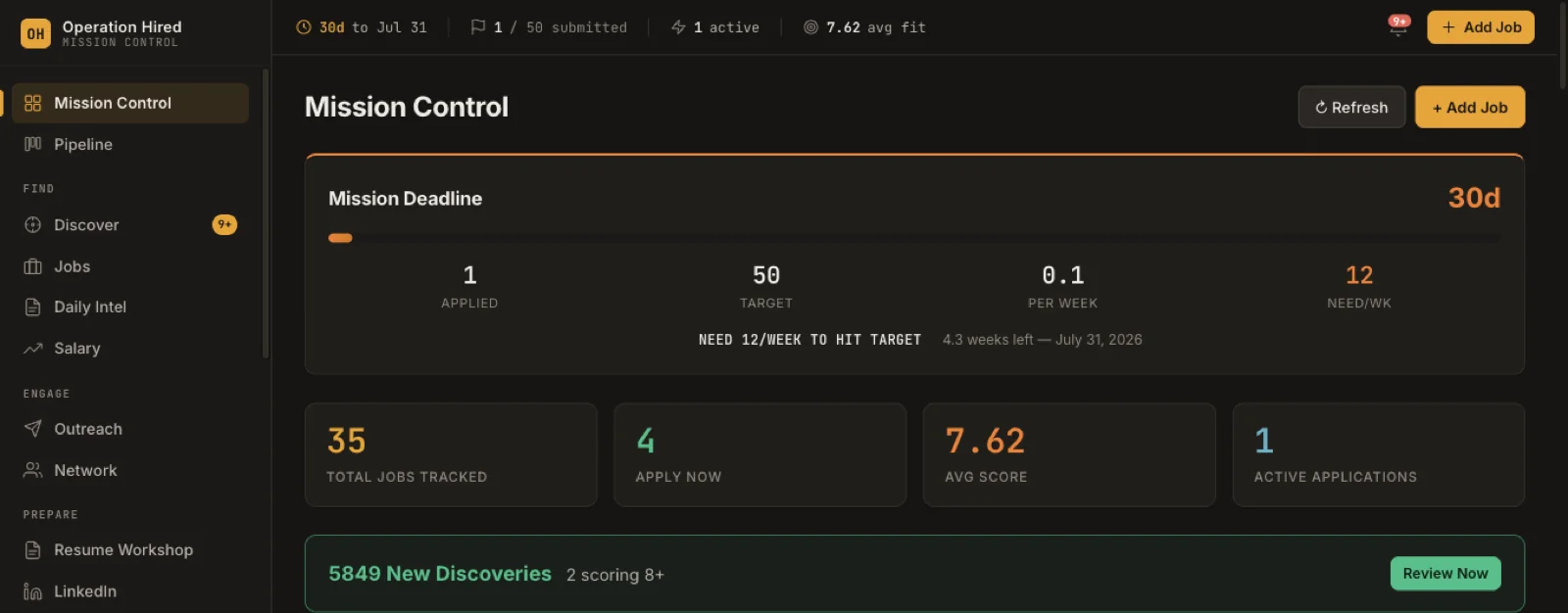
I needed to run a serious job search, so I built the system I'd roll out to a team. Not a spreadsheet and not a folder of bookmarks: a pipeline that pulls postings in, scores them, drafts the application, and keeps a record of every send. The point was never the software. The point was to make one person move like a staffed function, without losing the judgment that makes the work any good.
A discovery board, not a job board
Postings land in a local SQLite database and every one runs through a scoring model before I ever see it. So far it has scored 14,851 of them, and each score can be reproduced from the source data. What surfaces is a ranked board carrying the signals I actually decide on:
- Tier. Postings get bucketed by fit: role, seniority, pay signal. An early version was too generous with the top bucket, so I tightened it. Tier 1 dropped from a few thousand to about a hundred, which is what real fit should look like.
- Fraud. A set of heuristics flags the patterns ghost and scam listings share. That cut the flagged-fraud noise by roughly 80% in early runs, so the board stays honest.
- Freshness. A sweep re-checks live postings against the source job board and is deliberately conservative: only a hard
404or410retires a listing, while a timeout or a redirect is left alone so a real job is never dropped by mistake. The first sweep pulled 12 dead postings out of the pool, so I never spend a morning chasing a role that closed last week.
What a scored posting costs
| Metric | Value | Basis |
|---|---|---|
| Cost to score one posting | $0 | Scoring is deterministic code, weighted rules over a local database, with no model call. Every posting scores for zero tokens. |
| Where the model spend goes | Drafting only | Claude Opus 4.8 writes the tailored application, and only for a job I approve, never across the whole discovery pool. |
| Per drafted application | ~$0.04 | Measured from 76 logged Opus 4.8 calls: about 3,100 input and 1,060 output tokens each, the cost read straight off the API usage field. |
A fit report that surfaces gaps instead of faking them
Pick a job and the system writes a fit report, then drafts a tailored package off it. The report grades every requirement into three honest tiers, and the third one is the whole point:
- Matched. Direct, provable overlap between the requirement and my record.
- Equivalent. Different words, same capability, named explicitly so the mapping is a claim I can stand behind, not a stretch.
- Gap. Where I don't line up, it says so. A tool that scored everyone a perfect fit would be worthless. This one surfaces gaps instead of faking them, which is the only version I'd let near a real decision.
A human approves every send
Nothing goes out on its own. Drafted packages sit in a submission ledger behind a funnel view, and every send is a deliberate human action: I read it, I approve it, it logs. The automation makes the human faster; it never replaces the human. That line, drawn on purpose, is what keeps the whole thing trustworthy:
- A re-score pipeline re-ran every row (5,905 at the time, in June 2026) against the corrected model in one pass with zero errors, after backing up first.
- A test suite covers the scoring edges, the geo logic, and the fraud heuristics, and it's green before anything ships.
- Data-hygiene guards clear out orphaned rows and stop half-formed records from moving down the pipeline.
Every figure on this page is defined and dated on one sheet, including what "zero errors" does and does not mean and how the $0 holds up: how each number is produced and checked.
A follow-up ladder that never nags
Applying is the first move; the follow-through is where most searches go quiet. Once a package is sent, the system opens a follow-up ladder anchored to that submission: a hiring-manager note on day zero, a check-in around day five, another near day fourteen. It logs only the touches I actually make, and when a window passes it marks it closed instead of firing a reminder on its own. The tool keeps the schedule; I make the contact.
Guardrails I built in on purpose
A system that reaches out to the internet and drafts on my behalf needs limits it cannot talk itself out of. Two of them do the heavy lifting:
- An SSRF-safe fetch. The freshness sweep pulls live URLs, so every request runs through a guarded fetch that only speaks
httpandhttps, refuses private, loopback, link-local, and cloud-metadata addresses, re-checks every redirect hop against the same rules, and rejects the IPv4-mapped-IPv6 tricks that slip past a naive block. A job board should never be able to point my own tool at an internal address. - An anti-fabrication grounding check. Before any generated answer goes near an application, it passes a grounding check that rejects any number, dollar figure, or credential that is not already in my own record, and falls back to a plain, grounded template instead. The tool can help me say what is true faster; it is structurally kept from inventing what is not.
Why I point to this one
That's what AI enablement means to me: real workflows, honest guardrails, and adoption you can trust. It's a system that makes a lot of decisions, knows where it might be wrong, and keeps a person in the loop on the ones that matter. I'd rather show evidence than make claims, and that holds for everything I build.